

Recently, I worked with a client who had a good job, a decent salary, and two kids. She was sure she was terrible with money. Hopeless, she said. A lost cause. She couldn't quite explain why she felt that way. She just did.
We sat down and looked at the numbers together.
She wasn't bad with money at all. In fact, she was managing things quite well.
I've had the opposite too. Someone who seemed relaxed and confident. Everything fine, they said. No need to panic. And then we looked at the numbers. And they were not fine.
I've always been fascinated by the gap between how people feel about their money and what's really happening. This week, I read a research paper that helped explain why this happens.
Why Feelings and Financial Reality Don't Always Match
A new study published in the Journal of Financial Therapy, by researchers Olajide, Dinh, Watkins and Johnson, looked at more than 3,600 adults and found that the gap between how people see their financial situation and what the numbers actually show is strongly shaped by emotion. Not just personality. Not just background. Emotion. The way you feel, moment to moment, about yourself and your life.
The researchers focused on something called locus of control. This is a psychological concept about where you believe control over your life comes from.
What is locus of Control?
During COVID, many people saw a simple diagram with three circles, each inside the next. The innermost circle is the Circle of Control - things you can manage, like your spending, savings habits, and how you handle financial stress. The middle circle is the Circle of Influence - things you can affect but not fully control, such as your salary, investment choices, or money talks with a partner. The outer circle covers everything you can't control at all, like interest rates, inflation, layoffs, or government decisions.
The inner circle is what this research calls an internal locus of control. The outer circle is an external locus. And where your mind spends most of its time shapes how clearly you can see your own financial life.
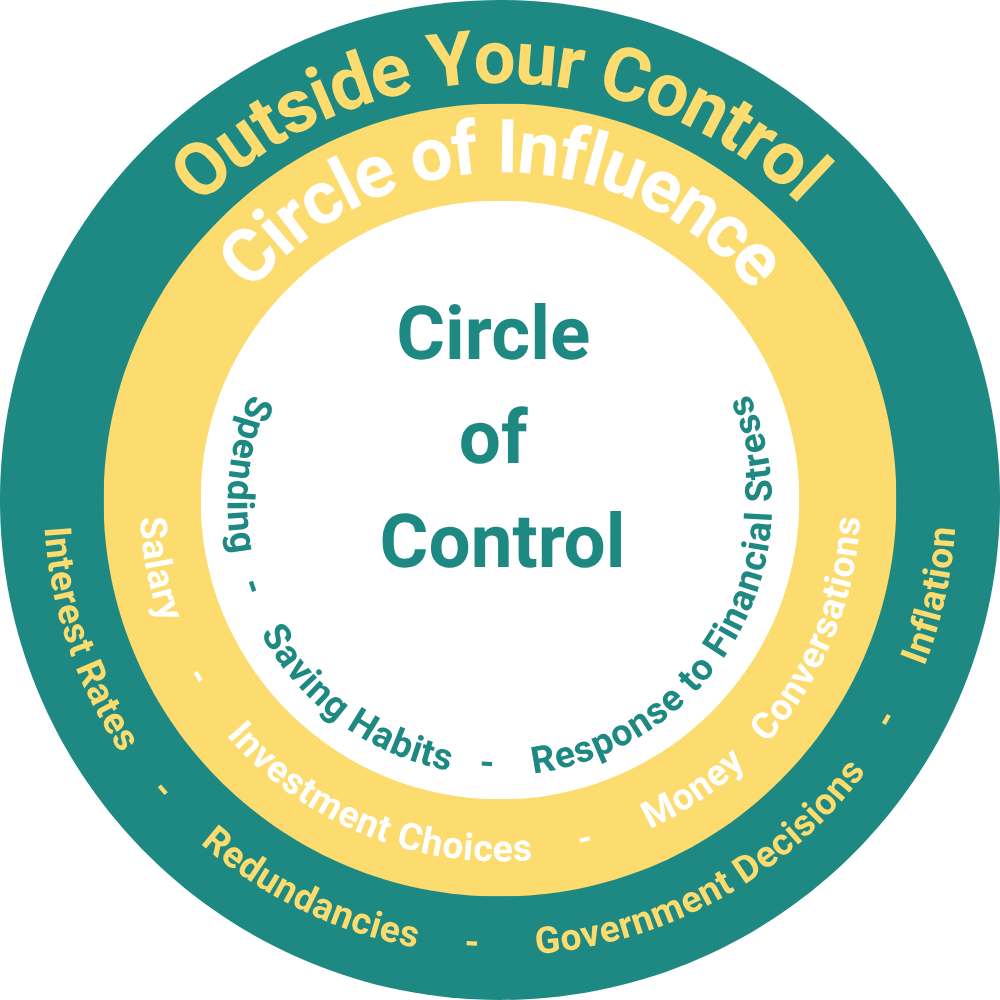
How emotions shape your financial wellbeing.
Here is what the researchers found. People with a strong internal locus tend to feel comfortable about their finances. Positive. Hopeful. And they rate their financial situation better than the actual numbers show.
People with a strong external locus tend to feel anxious and worried about money. And they rate their situation worse than the actual numbers are.
Both groups are looking through a lens. And the lens is not clear glass. It is tinted by how they feel about themselves and the world.
Here's where it gets interesting: this isn't just about money.
How self worth and self-esteem affect money
Think about the person who was told, as a child, that they were stupid. Or the one who heard, over and over, that they were a disappointment. Those words don't land in the money part of the brain. They land in the self part.
It's important to know the difference between two similar ideas. Self-worth is your sense of your own value and the feeling that you deserve good things. Self-esteem is your confidence in your ability to do things well. They are related. And they are different.
The person with low self-worth often doesn't believe, deep down, that they deserve financial security. They might earn good money and still feel, somehow, that it isn't really theirs to keep. The person with low self-esteem might feel incompetent around money, as if it is a clever person's game and they aren't clever enough.
Both create the same result. A lens that isn't accurate.
My client, who thought she was hopeless, had spent years carrying a story. Not just about money. About herself. She had been given messages, some loud and some very soft, about what kind of person she was. Those messages became beliefs. The beliefs became feelings. And the feelings became the lens through which she looked at her bank statements.
This is what I think of as the deeper layer of financial coaching. The money blocks, the inherited beliefs, the programming we don't remember receiving. You can hand someone a perfect budget and a savings plan. And if they believe, somewhere underneath it all, that they don't deserve it or aren't capable of it, the plan won't stick.
This matters enormously if you earn a good salary and still feel stressed about money. You might be underestimating where you actually are. Living in the anxiety, not the reality.
And it matters just as much if you feel broadly fine and don't look too closely. Because that comfortable feeling can be doing the work that the actual numbers should be doing.
How to check your financial reality?
What can you do with this? Start by noticing. When you think about your financial situation, are you responding to the feeling or to the actual numbers? When did you last sit down and look, properly, at what is coming in, what is going out, and what you have?
Not the vague sense of it. The actual thing.
And then ask yourself what story is running underneath. Not just about money. About you.